
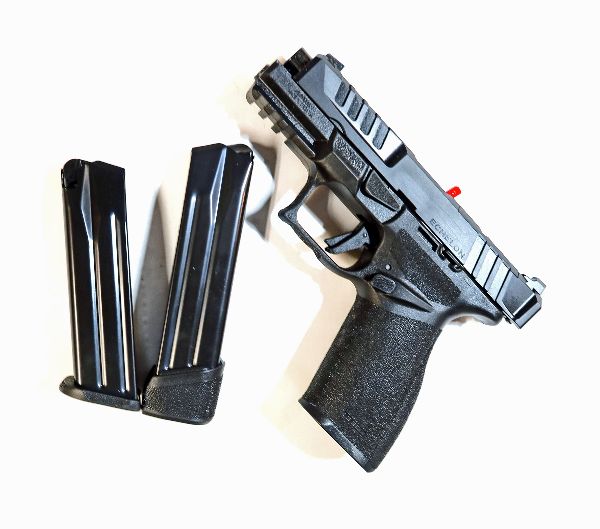
A term from the automotive industry is now a part of American handgun terminology: the crossover. Meant to describe a mashup of a passenger car and an SUV, some would call it “jack of all trades, master of none.”
Others might refer to it as “just right.”
For many people – according to a source from 2018 -- it is the best choice, reaching 40% of market share.
The crossover pistol – a “compact” upper over a “full-size” or duty lower (the receiver) – is not a new concept in the industry. When our dear over-spending rich Uncle Sam longed for a new military service pistol after WWII, they wanted a NATO caliber in a gun that wasn’t foreign in function or handling from the pre-WWI warhorse.
They got the Commander. An aluminum full-size frame – lighter than the old GI frame – was placed under a slide and barrel ¾” shorter. With a resize of the barrel bushing and the different barrel, extractor, ejector and a few other items, the original crossover came out before the term was used for automobiles.
The concealed carry crowd decried it because the longer grip frame was harder to conceal. The duty gear types liked it; with a duty holster a bit shorter to clear the car seat, the quicker handling – and cycling – shorter slide endeared the concept to them.
That doesn’t even include the weapon retention aspects of the gun – in an attack on a drawn handgun, the gun’s user has more to hold onto than the attacker.
GLOCK stepped into the crossover era, naming it with the G19X, the contender for the service pistol contract.
That has a familiarity to it.
It was only a matter of time before other makers put their mark on that space. And Springfield Armory did it with their service-grade Echelon.
It’s the fifth entry in the Echelon line that I’ve handled. I’ve concluded that it’s clearly service grade. As to its longevity, I can’t testify. My guess is that the line will be around and healthy beyond the expiration date on my birth certificate.
It’s solid.
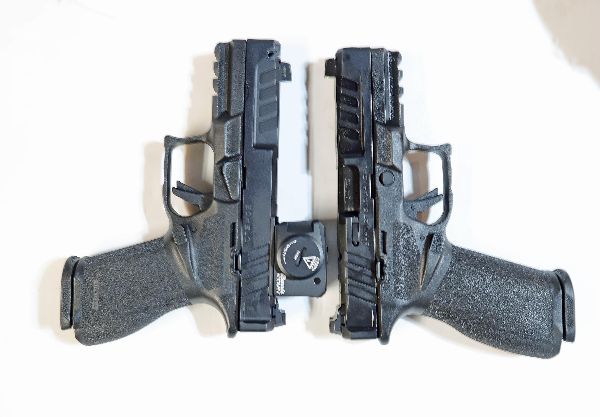
The difference between the Echelon 4.0C (Comp, with Burris RDS, left) and the 4.0FC (right) is clear.
The Echelon 4.0 FC (“F” for full-size frame, “C” for shorter barrel/slide) has the Echelon lineage, with the superior fixed sights, a maximum-compatible optics cut, the well-fitting ergonomics built into slide and frame, bilateral controls and large cargo hold.
The gun is supplied with a 17-round magazine and a 20-round magazine. The dustcover on the grip module is shorter than on the Echelon 4.5F service-size pistol.
The Central Operating Group – literally the “firearm” – is a unit that fits in the grip module. It’s compatible with grip modules across the Echelon line.
As the gun was received in February in a plains state, the effects of weather on the outdoor range were incompatible with this user’s comfort. I headed to Integrity Elite Firearms and their indoor range to check out the newly fitted blaster.
As it was a flying trip – and I wanted to get some rounds through the gun for this first impressions review – I took two kinds of ammo. One was the Black Hills 115gr. JHP-EXP load. The other was Federal American Eagle Syntech 115 gr. TSJ.
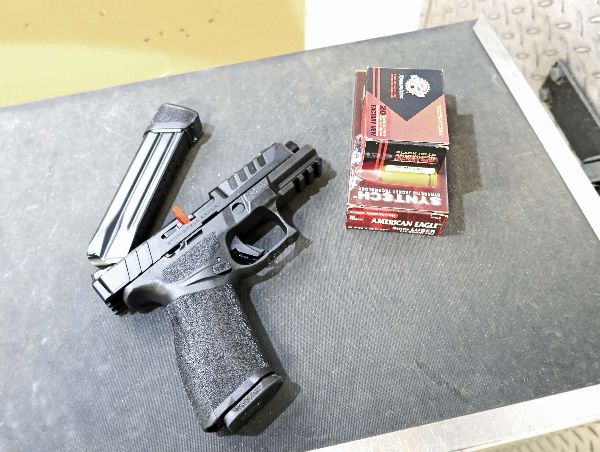
The initial range trip included Black Hills 115gr. JHP and Federal Syntech 115 TSJ ammo. Below, the difference between a standing 15 yard group and the upper group, fired from a seated rest at the same distance, both with Black Hills ammo.
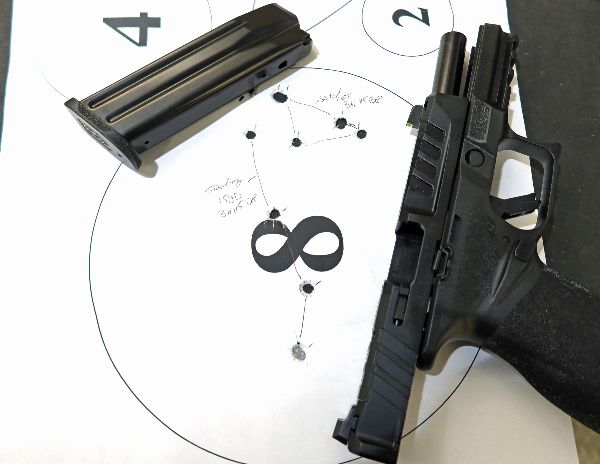
I quickly found that the gun was shooting high – very likely a function of my vision in the light on the indoor range. I shot the Black Hills load at fifteen yards, seated, resting on the shooting bench. The second five shot group gave me a 1 7/8” group. With the American Eagle Syntech load, I move the target back to 25 yards. That load yielding a 3 ½” group. I had a bit of trouble holding where I wanted due to lighting (compared to the outdoor range).
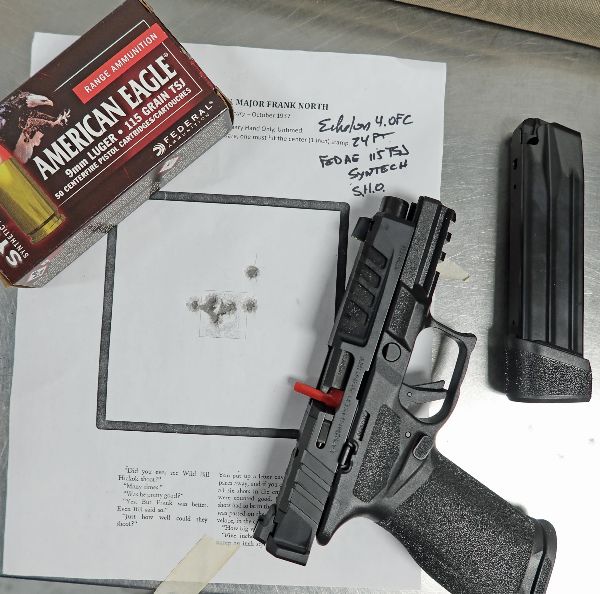
The next bit of shooting involved the “Shootist’s Challenge,” shot at 25 feet, one-handed. Of the six rounds fired, four were on the “stamp” image. All six were easily inside the “envelope.”
I had a “Dot Torture” target and shot it at varying distances; the target is moving fore-and-aft on this indoor range. Had I shot the bottom lines at three yards or five yards, rounds would have hit the floor on their way to the backstop.
I wasn’t having that.
I didn’t shoot every part of the Dot Torture as I was just getting a feel for the gun and where I was hitting. I noticed that on the “nondominant hand, unsupported” string, I shot a tight group on the right side of the “dot” with some rounds outside the dot.
That’s an interface issue, my grip on the gun, that I need to sort out.
My last rounds were fired on a First Person Safety FPS-1 target at seven yards. I put three pairs on the “body,” with all hits but one going into the “pump.” The last four rounds where singles to the upper aiming point. First two hit high – I then remembered that the gun was shooting over the sights for me with this load. I held low for the second pair of singles, hit the “base of the nose” with holes touching.
This first impression is favorable. Unlike some of the “cross-over” types of semi-autos, this one seems to be a bit jumpier in recoil. That could be from my lack of time shooting, but it’s something I’ll explore going forward.
As to the concept of the compact slide over the full-size frame, it’s my favorite style. So far, the Echelon 4.0FC is upholding that principle.
– Rich Grassi