
A few days ago, I had time to kill while my truck was being serviced, so I walked over to the big box sporting goods store, not intending to buy anything but to browse. In addition to confirming that the store’s single box prices for ammunition were much higher than I’d like to see, over in the gun section, there was an entire wall dedicated to 9mm handguns. The rifles were sorted, as you’d expect; by bolt-actions and autoloaders in what seemed to be an equal number of both varieties. What I did not see were any firearms chambering the .30 Carbine cartridge.
Now is the time when you say, “Duh, those are old grandpa guns. Of course they didn’t have any.” First off, I am a grandpa and I own a .30 Carbine gun. Secondly, it really does not seem to me to be all that long ago when I was browsing gun stores in my youth and M1 Carbines could be found in every shop.
Back during the days when I was writing for dead tree magazines, I reviewed several firearms in .30 Carbine. You might be surprised to know that lots of them were handguns.
Wait, handguns?!
Yes, I wrote articles about the Ruger Blackhawk, the Taurus Raging Thirty, and the AMT Automag III all chambered in .30 Carbine. Of the three, only the Ruger is still being produced. The Automag III is my great white buffalo and I have regretted letting it go for the last twenty-five years or so.
What has led me down this trip on memory lane you might ask? During a recent conversation with a young man in his thirties we were discussing the evolution of firearms and how we got to where we are today. I mentioned the M1 in .30 Carbine and my young friend had to admit that he knew nothing about it. I can’t truly fault him for that.
For all of his adulthood, the go to self-loading rifle has been some type of AR variant. I suggested to him that he pick up a copy of the book, A Pipe Hitters Guide to Small Arms & Weapons in which our pal, Nicholas Orr, details the history of many modern firearms and some of the most significant models in modern history. I contacted Mr. Orr and asked for permission to reprint the section of that book that discusses the M1 Carbine and he generously consented.
M1 Carbine
The M1 Carbine is interesting in that it has a similar beginning to the AR-15. Desiring a gun for support and auxiliary troops, the US Army wanted something more than a pistol, but something lighter and more convenient to carry than a full sized fighting rifle, such as the M1903 Springfield or the M1 Garand. So, the .30 caliber M1 Carbine seemed like the “Goldilocks” or “just right” solution.
Using a bolt mechanism that was essentially a scaled down version of the M1 Garand, the M1 Carbine was unique in that it used a detachable magazine and the new .30 Carbine cartridge. This cartridge used a 110 grain full metal jacket bullet that traveled just shy of 2000 feet per second. The .30 Carbine round was flatter shooting than the slow, heavy 230 grain .45 ACP cartridge and the felt recoil was minimal.
As history has shown, the idea of arming only support or auxiliary troops with M1 Carbines soon went out the door and demand for arms skyrocketed at the height of WWII. It didn’t take long before frontline troops were being deployed with these guns. The original magazines held 15 rounds of ammunition. When the M2 select-fire versions came along, ammo capacity was doubled with the advent of a 30 round magazine. These were given the nickname “jungle clips” by the GI’s who used them in the South Pacific campaign.
When WWII ended, the United States sold/gave literally hundreds of thousands of M1 Carbine to friendly nations. A good percentage also went into the US military surplus market and were sold in gun shops nationwide. During WWII alone, over 6 million M1 Carbines were manufactured in the semi-automatic M1 variety as well as the full-auto capable M2.
M1 Carbines are still being manufactured today by Auto-Ordnance and Inland Manufacturing. The Universal Firearms Company made a US civilian version of the M1 Carbine that mimicked the original but has some slight variations to the design. The Universal Carbines used the same magazines, ammunition, and a Garand-style action. Although out of business, Universal produced over 420,000 of their carbines. The M1 Carbine and the variants of that gun saw combat use in Europe, Asia, Africa, and South America.
.30 Carbine Today
I suppose it was a year or two back when one of our Student of the Gun listeners posed the question, “Do you think the M1 Carbine is still a viable home defense gun?” To which I replied that it most certainly was viable when employed by trained hands.
While the round doesn’t produce the hydrostatic shock of the .223 Remington, a 110 grain bullet moving at 1990 feet per second is not exactly a love-tap either. Tens of thousands of Japanese and German ghosts would attest to the lethal efficiency of the cartridge. If you’re looking for defensive loads, there are many good ones still available including a 110 grain FTX load from Hornady.
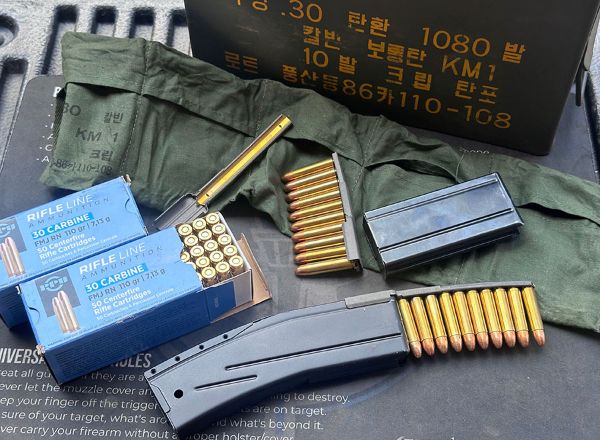
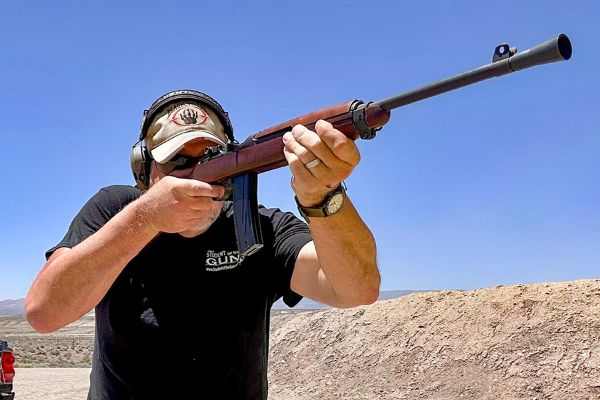
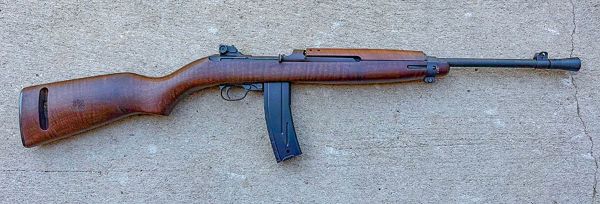
In my personal armory, I have an Inland Manufacturing M1 Jungle Carbine. In addition to American made factory ammunition, I have been working my way through a 1080 round can of Korean surplus ammo. If you find such a thing at a gun show, I would grab it up. The Korean ammo was designed for military issue and comes in bandoliers with the ammo loaded on 10-round stripper clips. What is really interesting, at least to me, is that every clip of ammo had its own speedloader attached.
Of all the United States allies, the South Koreans are likely the biggest user/holder of WWII era M1 Carbines with over 600,000 thousand in inventory. Also, if you find M1 Carbine magazines in brown paper wrappers at a gun show, there is a 99 percent chance that they are Korean-made.
My thirty-year experience with the M1 Carbine has been that the magazines are often the Achilles’ heel. You need to test them in your gun for reliability. My practice is to number all the mags with a silver paint pen and sort the wheat from the chaff. Also, M1s like to be clean and well-lubricated. Don’t be stingy with the gun oil. Disassembly for cleaning is not a straight-forward as a GLOCK or an AR, but Youtube videos abound.
In a world where plastic and aluminum guns are the norm, it’s nice to get out to the range with some hardwood and steel. If you find yourself wanting to channel the experiences of your grandfathers and great-grandfathers, a trip to the range with an M1 Carbine is a worthwhile endeavor.
M1 Jungle Carbine
Caliber: .30 Carbine
Action: Semi-Automatic
Capacity: 15 / 30
Barrel length: 16.25″
Total length: 34″
Barrel groove: 4
Twist rate: 1 x 20″
Weight: 5lb 3oz
– Paul Markel, Shooting News Weekly