
For a variety of reasons, I couldn’t use the club range, outdoors, and needed to get some trigger time in. This involved trips to the indoor range I prefer to use. The list of things that make operators of indoor ranges nervous include some things we should practice: drawing from a holster among them. But I can do a lot of that work in dry practice.
Besides, as I’m moving to precision work, finally, after a career of sustained fire on comparatively large targets at short distances, I did this practice on bullseyes with 22 rimfire pistols.
The idea is to make a hole in the paper 25 yards away. Having the hold, the visual aspect and a disciplined trigger press are relevant. Just making noise isn’t.
Bullseye distills pistol shooting down to fundamentals. I’ve seen a champion-class shooter describe it as three elements, but each of those elements are made up of discrete tasks, each of which have to be in place to make a hit in a 3.36” circle at 75 feet (the indoor range I use doesn’t have a fifty-yard bay).
I’m in no risk of keeping the lion’s share of my hits in that circle, but I insist on keeping them on a repair center. At my age, that takes some effort.
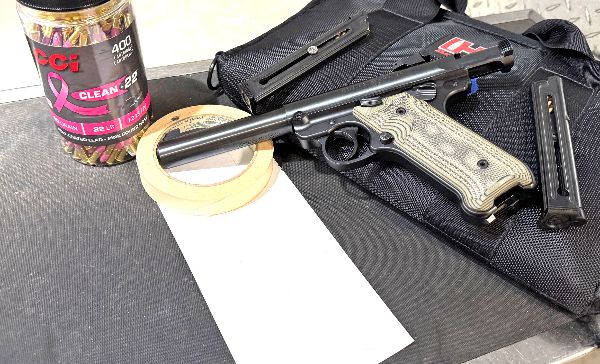
The first trip saw use of the Ruger Mark IV Target; 5.5” bull barrel, metallic sights, the rear adjustable for elevation and windage. The gun has Hogue, Inc. “G-Mascus Green” G10 stocks in place of the factory stocks. Otherwise, there are no modifications.
The ammunition I selected, based on concerns about indoor ranges and lead ammunition, was CCI CLEAN-22. While it’s geared more to prevent barrel fouling and making a suppressor easier to clean, I reasoned that it could be a bit more healthy than uncoated lead projectiles.
I’m still careful to make use of hand cleaning wipes that are made to remove contamination of this sort.
Using a B-8 repair center for each segment, I’d shoot a pair of stages right-handed, replace the target and shoot a pair left-handed.
When trying to learn a physical skill like shooting, it’s good to work “mirror image” to get back to being a complete duffer and to iron out bad habits.
Each stage had two five-shot strings. The first effort saw a result of two rounds out of the black, a 7 and an 8. It ended with a score of 93-3x. This isn’t medal winning, but it gave me some false confidence. The second string had five out of the bull, with a mere 85-2x result.
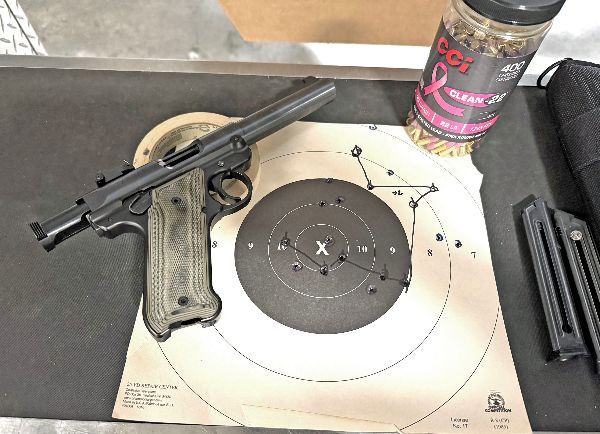
Left-handed shooting followed my sad second stage performance with a product of an 87-1x and 86-2X. I saw I was tending right with the left hand, indicating I didn’t have the gun properly centered.
There were 20 hits on each repair center; that duffer’s goal was met.
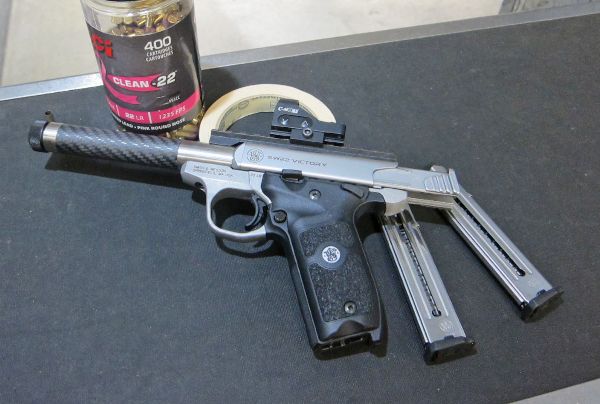
A few days later, I got back and decided I’d see what an optics equipped pistol could do. The gun was the Smith & Wesson SW22 Victory, this one with a Volquartsen barrel and a C-More RTS2 red dot optic.
The trigger is a target trigger; the barrel is superb. The reticle has the round about .75” below the point of aim at five yards; my hold with an optic that high is vastly different than the Ruger with metallic sights.
Shooting on a B6 repair center – instead of the B16 center I’d intended – made scoring irrelevant. I followed with ten rounds right-handed and ten left-handed using Remington Golden Bullet 40 grain ammo on the proper B8 repair center. The extreme spread on the B6 was right at 6-inches.
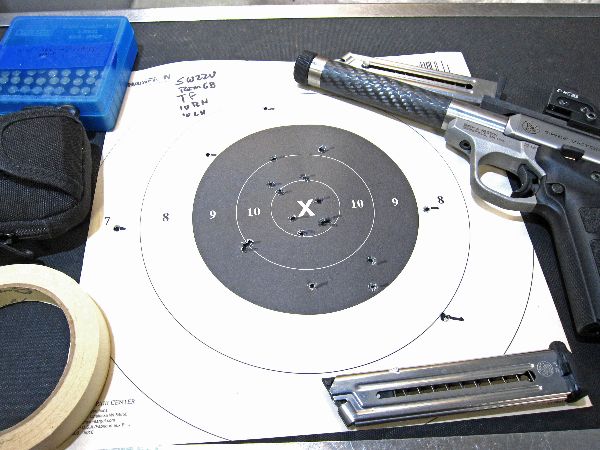
The 8-ring (bull) measures 8-inches. On the B8, I shot 184/200-7x. That group was 7 1/8”.
With the iron-sighted Ruger, my groups were 8” right-handed and 6 ¼” left-handed.
My left-handed effort on irons closely approximated my best effort with the optics-equipped match pistol.
My hold is going to have to be a lot better – and trigger control too – to get those groups down and scores up.
That said, there’s something therapeutic about bullseye. It’s immersion in the essentials of pistol shooting and requires focus that prevents the wandering mind, particularly in this digital age.
– Rich Grassi