
One of the biggest issues with quick use of DA revolvers (aside from the stout triggers) is the length of time it takes to press through the trigger, consistent with making a solid hit.
Similar to the ‘split time’ non-issue, in a critical incident time is nothing … at the same time that it’s everything. If there’s a violent criminal assault and the attacker takes even a nonsurvivable hit, he can still function at a deadly level for up to several minutes … let alone fractions of a second. But to determine simple speed to the first hit, that’s a lab experiment.
In a double-action revolver, pressing the trigger results in the hammer being cocked as the cylinder turns a fresh cartridge into the ignition line – from the hammer- to firing pin -to chamber- to bore – releasing the hammer and firing the cartridge. That’s a lot of activity going on, but much of it happens simultaneously.
A cocked revolver (or autoloader) requires the trigger to move only far enough to trip the sear and let the hammer go to strike the firing pin (or to allow the striker to fly forward). With some striker-fired autoloaders, some rearward movement of the striker initiated by trigger movement is required to get enough spring tension to cause the forward moving striker to create ignition in the cartridge. In terms of the time it takes from stimulus to trigger press to ignition, there’s not a lot of difference.
The DA revolver fired double action does require a number of moving parts to move. How much difference is there?
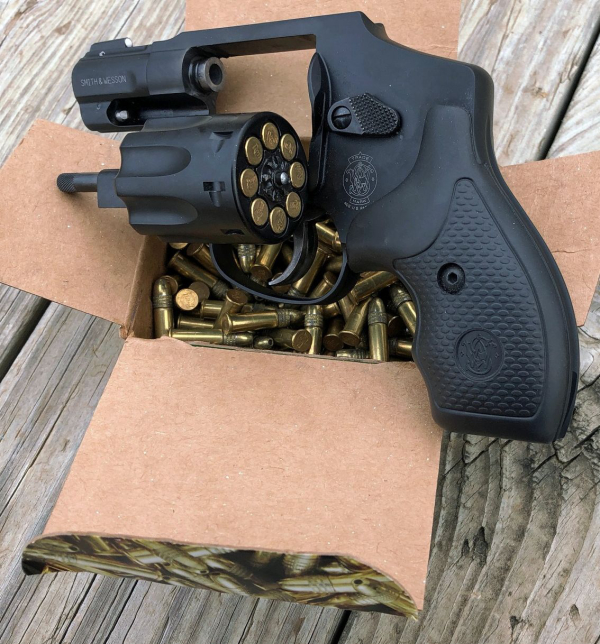
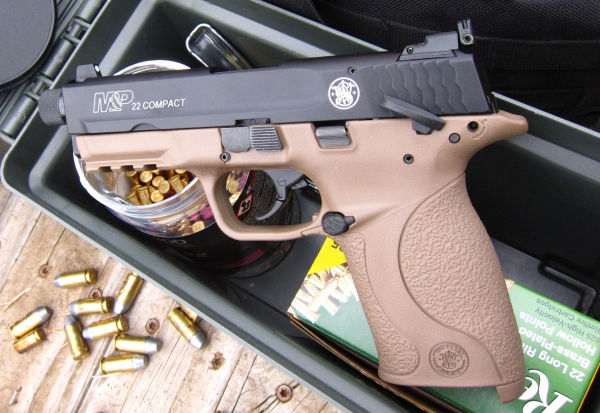
I set out to test that with a pair of rimfire guns – the S&W M43C, a concealed hammer, DA revolver and the M&P22C, a single-action hammer fired 22 auto. I used the PACT Club timer to time the exercises and a B-8 (CP) 25 yard timed/rapid fire bullseye target. The distance, for the revolver, was five yards and the drill is taken from Larry Vickers. Not sure what he calls it, but I call it the “Demand” drill.
The course is simple. Have the timer set to random delay start – so you can press the button and get ready to shoot. The starting position is aimed in at the target, finger on the trigger. On the autoloader, I take the slack out of the trigger and have it at the “wall.”
With the revolver, I simply have solid tension on the trigger without moving the cylinder – a minor handicap.
When I hear the timer’s alert begin to sound, I press the trigger. My grip is firm and I’m aimed in; I try to cut the “beep” in half with the gunshot.
What does the target do? It keeps me honest. A fast miss accomplishes nothing.
I used the M43C for eight rounds, the capacity of the cylinder. The grip was hard as I could get it on the ca. 11-ounce revolver – against the heavy DA trigger. My times ranged from .21 at the long end to .16 at the fast end. All hits were inside the nine ring – the “shaded” part of the target.
Moving back to seven yards – the autoloader has real advantages – I did the same exercise with the M&P22 Compact, also for eight rounds to keep it consistent. At the long end, it took .20 second. At the fastest, it took .13 second. Hits were all in the “bull.”

So what did I prove? There’s not enough difference to matter – if you do your part.
Consider that this isn’t a ‘gunpoint’ drill; that’s not a relevant part of the use of force these days. It is a relevant grip/trigger control drill to demonstrate that grip is more critical than what you’re doing with the trigger. And it teaches you not to ‘flinch.’
-- Rich Grassi