
Due to the early onset of wintery weather locally – and a thing called “life” – I’ve been unable to make range trips regularly as I had been throughout the year. I still have factory-owned heaters that need some live fire for evaluation.
A few weeks back, I had the weather opportunity but had to go around mid-day. The problem is if conditions are good for me, conditions are good for other club members. I hate getting in their way to do work.
I chanced it, taking the Ruger Custom Shop guns previously discussed here to the range.
To catch up, the guns included the Doug Koenig-marked SR1911 Competition 9mm and the 10/22 Competition Rifle to which I added a modest red-dot optic, the UltraDot Pan-A-V.
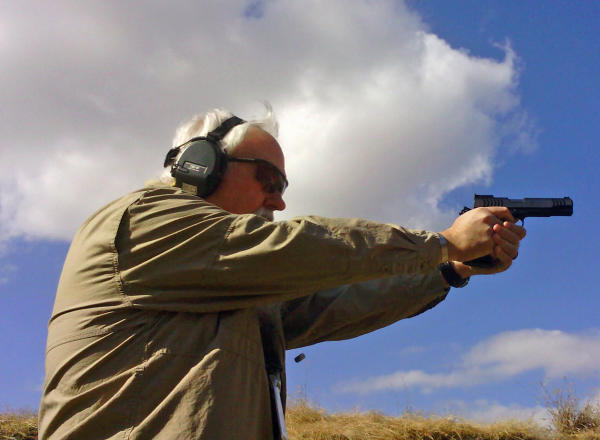
As this was a short trip, to shake out some test & evaluation samples, I didn’t take lots of ammo. I’d done some hasty accuracy work with the SR1911, but wanted to speed it up a bit. I took an NRA B-8 bullseye repair center and stepped out five yards. As I’d already done some shooting with another sample and was warmed up, I started with a ½ second cadence drill: breaking each shot ½ second after the previous shot, to check handling with just a little bit of speed. The target shows the last five rounds of the ½ second cadence, followed by the “1/4 second” cadence drill: I had one trigger “snatch,” my fault. The remainder clustered in the bull – and didn’t even use all of that.
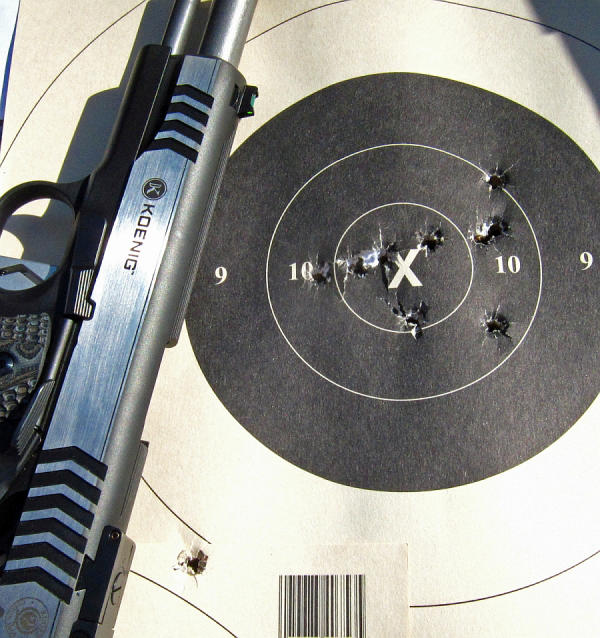
The Federal “Aluminum” range ammo I was using isn’t known for being hot ammo: the slide travel felt slow, but the sights were always in the bull when I smashed the trigger. It seems to run fast enough for me. I also noted that the factory overall length ammo resulted in no “nose-dive” stoppages so far; this malady seems to be a thing with the typical 9mm 1911. It’s not with this one, at least that I found to this point.
I quickly gathered my gear and raced down to the rimfire range. Sadly, I’d just started to get set up when the traffic arrived and I was constrained to a pair of fifty-yard groups from the bench with the 10/22 Competition Rifle. The pair of loads fired for groups included Federal Hunter Match, a load that’s remarkably accurate in other guns (including a few Rugers), and CCI Standard Velocity.
The first trip pretty much got the optic/gun zeroed at closer range. This was the first real attempt to stretch the legs of the little gun. The hasty rest helped me get a pair of interesting 10-shot groups.
I could make guns look better by firing 3-shot groups and usually shoot 5-shot groups. Gunblast’s Jeff Quinn tells me I’d do better to fire one-shot groups. There may be something to that.
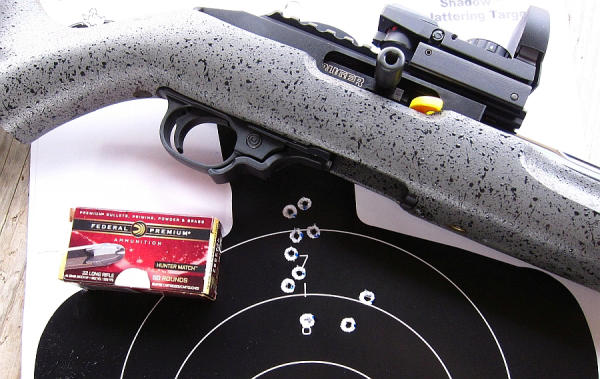
I had no reason to worry. Federal Hunter Match put 10 rounds into 2 5/8”, with seven of the 10 rounds clustering into 1 ¾”. That’s shooting within the “dot” of the reflex sight. The CCI Standard Velocity, a reasonably priced load, had 10 hits into three inches, with 7 of them dropping into 1 ½”.
I’d been concerned that the autoloader might not function with the Standard Velocity load, but this gun works just fine with them.
The weather cleared a few weeks later. It was cold, but I tried some other loads with the 10-22 Competition. I had a small supply of Geco .22 l.r. “rifle” and “semi-auto,” as well as Eley’s “action” 22LR ammo.
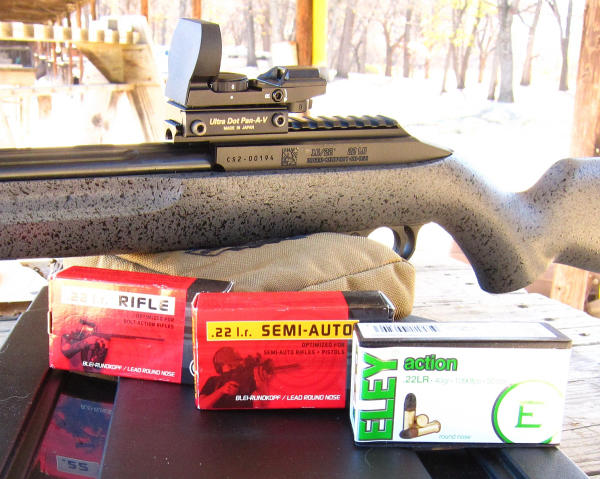
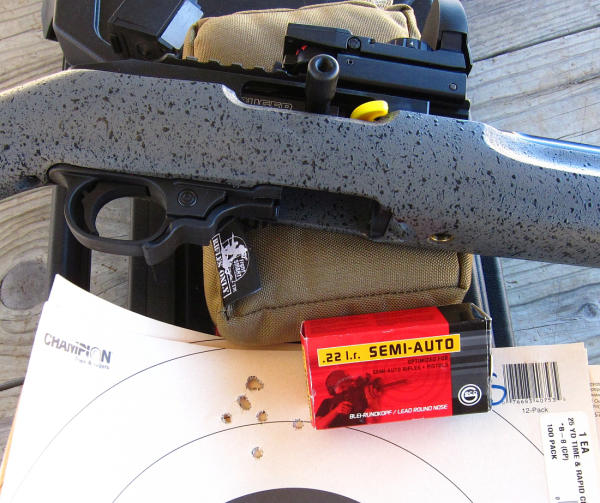
I stayed with the ‘fifty yard, 10-shot group” format for consistency. The Eley action printed a vertical 3 ¼” string, putting 7 of 10 rounds into 2”. Geco rifle printed a round 3 ¼” group, likewise having 7 of the ten rounds printing into two inches.
The Geco semi-auto load put ten rounds into two inches at fifty yards. Seven of those went in just under 1 ¼”.
I think I’d have called this gun the “10/22 Hunter” – it’d be great for that application as well.
If you’re interested in custom guns, competitive shooting sports or you just like Rugers, you’ll be happy with these Custom Shop guns.
- - Rich Grassi