
Today’s feature is from our parent service, The Outdoor Wire.
With ammunition prices moderating I’m spending more time at the range than I have in some time.
Stratospheric pricing and caliber shortages over the past 24 months put serious dents in my personal practice. Training time with ammunition once measured in hours dropped to minutes. Round counts were measured by the magazine or cylinder rather than by the box.
As is the case with any perishable skill, results, and enjoyment - plummeted.
Currently, I’m confident enough in the ability to replenish personal ammo supplies to start figuring in more practice time. Not testing time -that has to happen - practice and training time.
It’s more expensive, but today what isn’t?
Fortunately, most of my practice today is focused on the basics, not the higher-level skills needed for competition. For the basics, .22 caliber rimfire quickly establishes whether or not you’re following best practices.
When it comes to making exact hits, a teeny-weeny .22 rimfire target confirms best practices- or reveals flaws as well -or better-than heavier calibers.
In my “competition” days, my competition gun - the Smith & Wesson M&P in 9mm -had a companion piece in the M&P 22 rimfire. The controls were the same, although the factory .22 trigger didn’t compare with the Apex Tactical trigger in my M&P Limited pistol.
Today, I’m more leisurely with my practice. It’s recreational. For me, nothing says recreational shooting better than a revolver. More specifically, the newest iteration of Ruger’s immensely popular Wrangler .22 revolver, their new Super Wrangler.
For practice, I enjoy the adjustable sights for checking my bullseye basics. And it fits -although not precisely -into my old cowboy action holsters. That means the occasional session of from-the-holster practice is also an option.
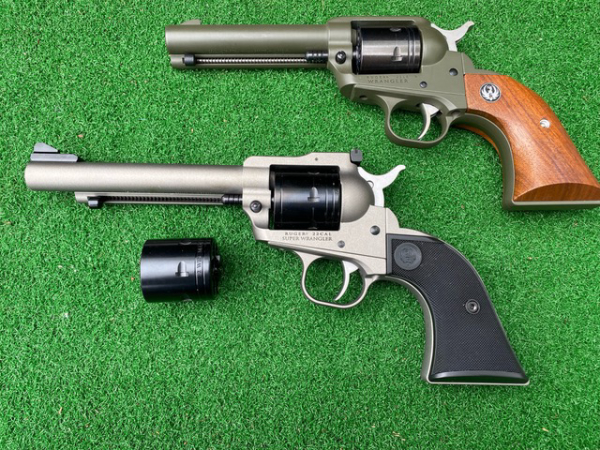
Although I don’t use the .22 Magnum cylinder often, it has definitely been swapped-into the Super to be my “kit gun” -when wandering around the woods with my cameras.
For larger-framed guns, a comparable .22 means more practice for less money. But they don’t fit into all practice scenarios.
For the compact/subcompact/micro-compacts, there’s simply no substitute for shooting the gun and ammunition you plan to carry.
The only way to get better with those little guns is to shoot them.
But that brings an added benefit, too.
When you get better with the little guns, you’ll find the bigger ones much easier to control and shoot accurately.
Practice is where you refine skills, identify problems, and correct mistakes. Cross training on a variety of platforms will improve your overall shooting abilities.
Effective practice doesn’t always mean high round counts, long range sessions, or shooting to the point of exhaustion or total frustration
When shooting for fun, I focus on the things I’m doing best.
When practicing, I’m looking to identify weaknesses -and focus on them. If I’m having trouble correcting them, I don’t speed up, I slow down. Occasionally to the point that I leave the line, take a seat and try to visualize what I want to do versus what I appear to be doing.
If I can’t identify an issue, I stop, unload my gun (while still on the line) and go to a safe gun handling area. There, I check all my equipment. The other day, I was frustrated while trying to run a rapid-fire drill using a red-dot optic. Three good shots, two wild ones. Repeatedly. So, I unloaded, left the line and discovered a couple of loose screws allowed the optic to “jiggle” under rapid recoil. A quick adjustment, two drops of blue Locktite and I was back in business.
The majority of my practice is indoors, and that puts limitations on how I can practice. Holster time is limited, and plate racks and reactive targets have been a no-go. Until recently, that is.
The solution to my indoor practice on plate racks is a story for next time.
We’ll keep you posted.
— Jim Shepherd